
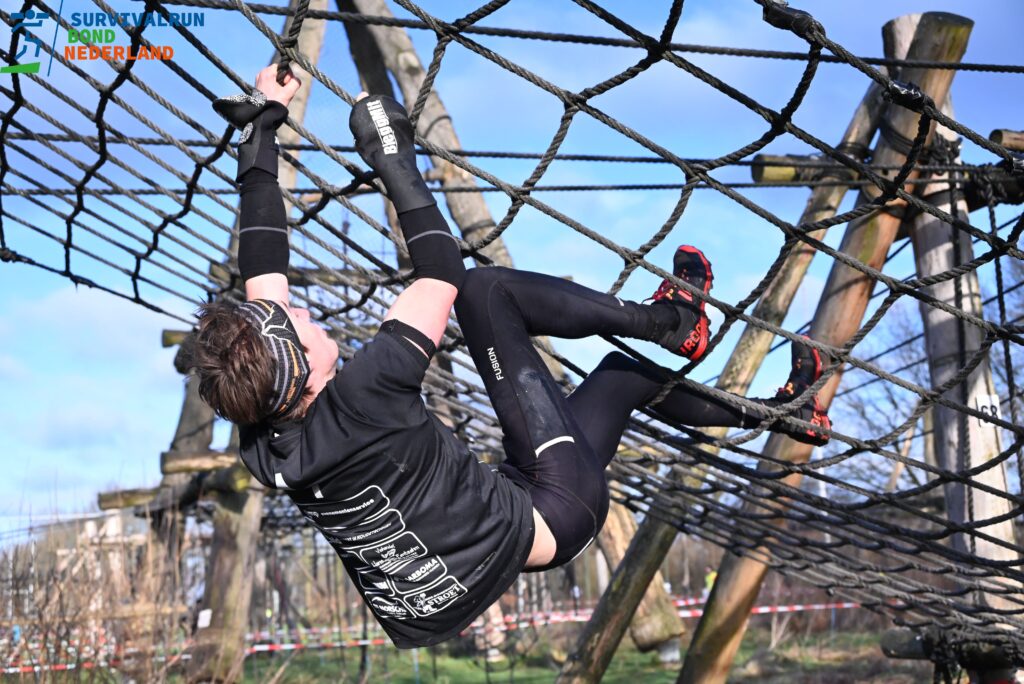
Sunday marked the classic event in the world of Survivalrun: the race in Beltrum. This run has been around for 33 years with a unique formula: off-road running, obstacles made of ropes and logs, and above all, challenging and cold conditions. In my view, completing this 23km run is a fantastic achievement for anyone who considers themselves a survivalrunner. I believe that every top- survivalrunner has winning this classic race at the top of their wish list.
After the rather literal cold shock I experienced during the Dutch National Championship in 2018, it wasn’t until 2023 that I felt fit enough to make another attempt at the podium. Unfortunately, COVID-19 disrupted those plans, and I was too sick to participate. The goal was clear after that: 2024 had to be the year. And what an edition it would turn out to be. For weeks, the water levels in the country had been exceptionally high, submerging fields and forests. In addition to that, temperatures dropped below freezing, accompanied by a brisk wind. In other words, conditions just as the run in Beltrum is meant to be.
The Course in Beltrum
The course in Beltrum is unique in several ways. The course is almost entirely off-road, which means you hardly ever run on paths. The terrain consists of forests and fields and meadows, as it was originally inspired and designed for drag hunting on horseback. The high water added an extra dimension because everywhere you ran, you were in the water or sinking into the mud. The obstacles are as classic as the run itself, meaning everything is built with thick logs and ropes, no smooth beams or convenient connectors. You won’t encounter obstacles that require exotic techniques. You can get quite far with the fundamental basic techniques. However, this run is sometimes underestimated. The challenge lies not in the difficulty of the obstacles but primarily in the conditions under which you have to complete them.
The race
My race plan for the day was as follows: in the first part of the course, I wanted to gauge how the challenging conditions would affect the race. In other words, how fast could I run across the waterlogged fields, and how tough would the frozen ropes and beams be on my hands. On a good running section, I planned to accelerate and create a gap, which I could then manage without exhausting myself.
The starting signal rang out, and we were off. Thom van Cappellen immediately set a nice running pace, and I tried to keep up. We passed the first obstacles and crossed several fields. I found myself thinking, “If I’m already sinking up to my ankles in mud, 23 kilometers could be a very long race.” Meanwhile, we were followed by a car with loudspeakers. Through a live broadcast, the spectators were kept informed about the progress of the race. It had a somewhat comical aspect: athletes battling it out in the mud, followed by a group of cyclists and a car with loudspeakers in a picturesque winter landscape.
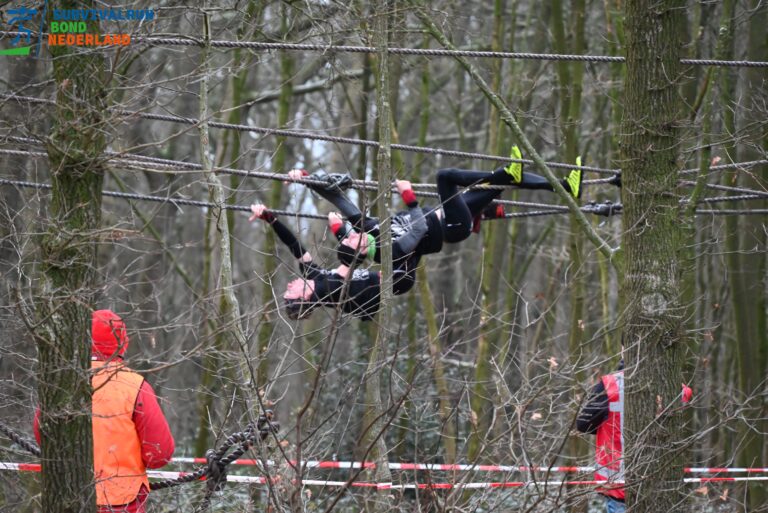
After each obstacle, we disappeared back into the woods. The branches of the undergrowth slapped against my face, and I almost stumbled a few times, nearly getting stuck in a blackberry bush. I couldn’t see much right behind Thom. I had two options: either let myself drop back or pass him. After some hurdles, I saw my chance. A nice stretch of bike path for a few hundred meters before heading back into the mud. I picked up the pace and created a gap, only to lose it at the next obstacle. I walked across the final horizontal beams of an obstacle and was sent back. Apparently, I was supposed to crawl here. We ran side by side through the course until we reached an obstacle block. I wasn’t exactly sure what happened, but once again, I created a gap. Meanwhile, a brass band played an Italian partisan song. In my head, I thought, “Bella ciao, ciao, ciao,” as I started running. I quickly built up a nice lead until there was no one in sight in the field behind me.
Being Stubborn
After a series of obstacles, I reached Survival Beltrum’s training ground. A few combinations awaited me here. Gripping wasn’t going as smoothly anymore. My hands were cold because my mittens had gotten wet. I thought, “Well, that’s great. Those mittens are always too warm to wear until you actually need them, then they’re too thin.” Luckily, I had a second, thicker pair that I had given to Justien, who was supporting me. She asked if I wanted to change my thermal shirt, but being stubborn, I declined because I didn’t want to waste any time.
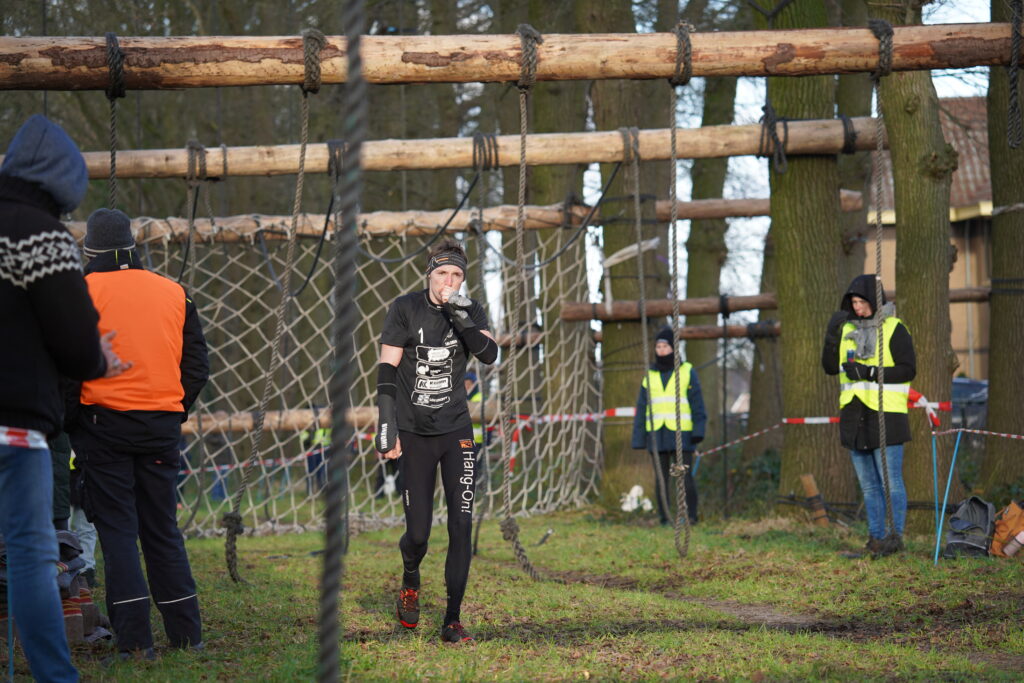
The second part of the course exposed me more to the wind. I noticed that despite the new mittens, I was still cooling down. But the obstacles were still going smoothly, so what was there to worry about? At the “gnome ropes’’ I was really cold, but I still managed to get through easily. I still declined well-intentioned assistance here. In the final section, there was a kayaking part where halfway through, you had to make a swing-over from your boat. I could feel the cold from the paddle’s metal seeping into my hands. I struggled to grab the frozen top beam and climb down again. I thought, “This could become a problem…”. At the next combination, I ran into trouble for the first time—an arms only part involving: a short rope, a triangle, and a monkey’s fist. Normally, not a problem at all, but now, even just holding on was a challenge. Fortunately, I completed the obstacle in one go and started the last kilometer slightly concerned.
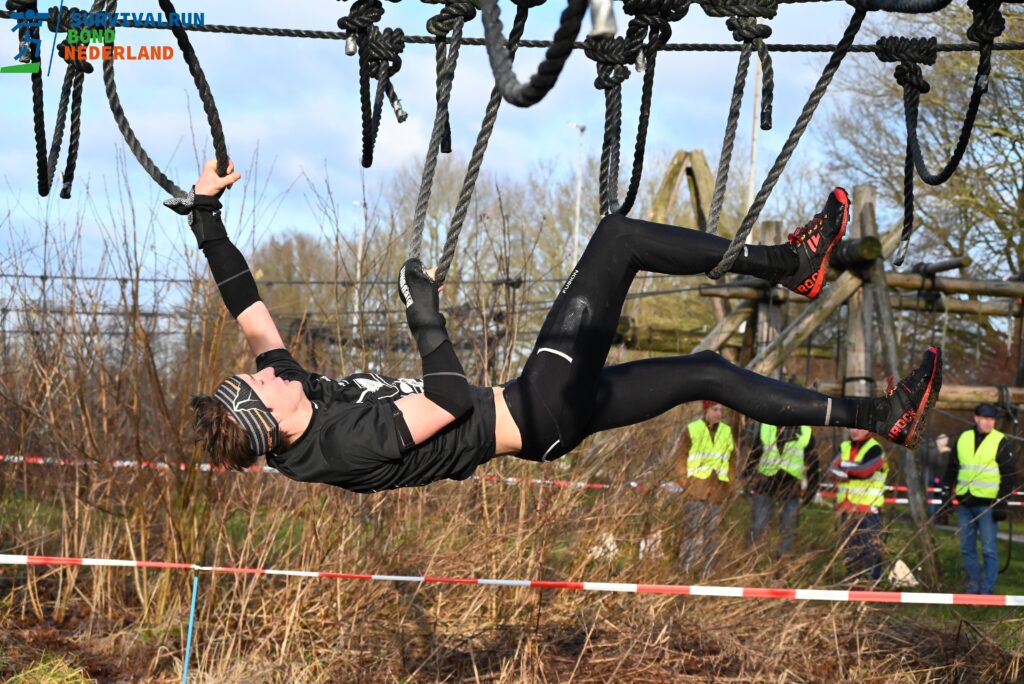
Numb Hands
I envisioned the last stretch—just one more time through the training ground, a bit of rope traversing, and wood chopping. Playing it safe, I should make it through just fine, with minutes of lead to spare. But this idea was quickly shattered. On the training ground, I encountered ‘’grip planks’’ Running on sheer determination, I barely managed to conquer this with numb hands. Then, I was directed under a net and had to traverse a rope using my hands. At that moment, it seemed an impossible task. My hands had lost all coordination, and gripping was impossible. After several failed attempts, I saw Thom pass me quite easily. As a last resort, warm chocolate milk was poured over my hands to warm them up, but it had no effect. I had to resort to elbow work, and after several attempts, I finally succeeded. Thom was already well on his way to the finish.
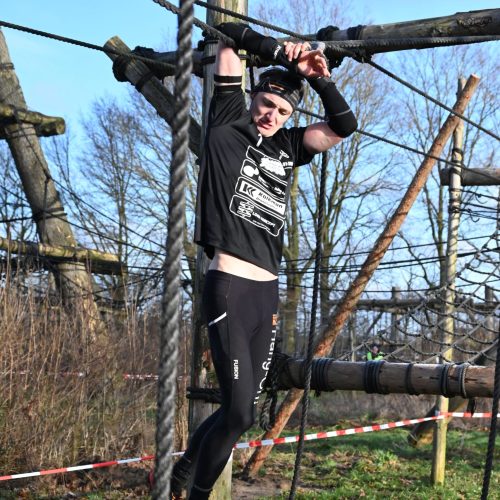
he last part of the run passed in a blur. Everything felt too strenuous. I tried to be creative so that I used my hands as little as possible in the obstacles. The wood chopping at the end went okay, but I got stuck again in the final obstacle. It involved a series of loops where you had to pass over a beam. I simply couldn’t maintain a grip on the rope. Kerst Wind and Barend Westerveld passed me. I felt somewhat hopeless. There was nothing I could do. Eventually, I crossed the finish line. At that moment, disappointment was an understatement. How could this have gone so wrong?
Looking back, I realized I should have dressed better to stay warm and not been so stubborn about replacing wet clothing promptly. Now, I had experienced the full “Beltrum experience,” something so familiar to many athletes. Maybe I’ll have my redemption in 2025?


Hee Jesse, leuk stuk en leerzaam voorzowel jezelf en anderen! Goed dat je er wat humor in verwerkt hebt ook!!
Als zeer ervaren kou-kleum kan ik je advies be-amen. Zelf ging ik jaren geleden zover dat ik soms niet eens meer helder kon denken door de onderkoeling. Eigenwijs zijn kun je denk ik niet afleren, wel het gedrag dat er uit voortkomt…
Overigens heb ik het dit jaar heerlijk warm gehouden afgezien van 3 vingers waar helaas nog steeds geen gevoel in zit.
Groetjes Jora
Mooi verslag Jesse!
Erg beeldend omschreven, herkenbaar.
Op naar editie 2025!
Prachtig verslag om te lezen. Helaas geen nummer 1 maar desalniettemin een topprestatie waar je trots op kan zijn.
Herkenbaar Jesse! Ik deed slechts de halve maar had in de eindhindernis ook geen knijpkracht meer door de omstandigheden.
Kop omhoog en op naar de volgende!