
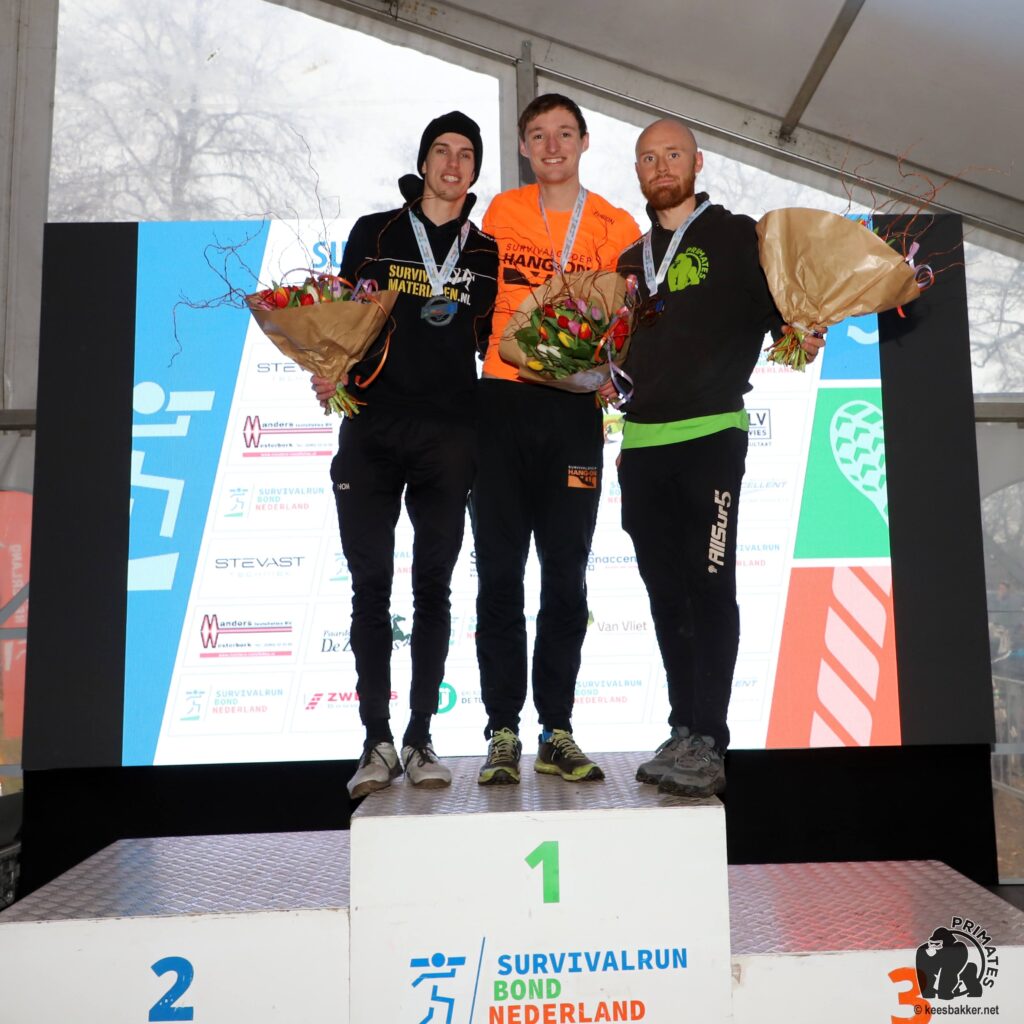
Last week, the Dutch National Championship (NK) middle-distance survival run was on the schedule in Westerbork. Last year, I won the MSR in Westerbork, and with the NK at this location, my goal was clear: complete the trilogy as the Dutch champion in the short, long, and middle-distance survival runs.
The course was familiar to me: a 12km loop through the woods, heathlands, and the village of Westerbork. The obstacles were scattered throughout this course, with short running sections continually alternating with obstacles. This made the course challenging; the intensity remained high throughout the race. The running sections were too short to recover from the climbs, and the climbs were too short to lower the heart rate. It didn’t matter whether you were a good climber, runner, or all-rounder; everyone could perform well on this course.
On the day of the race, the temperature was below freezing, but a significant difference from Beltrum was the absence of a harsh wind and water. However, this time, I wouldn’t fall for it. I was prepared: a long thermal shirt, headband, mittens, and even heat packs inside those mittens. After a short warm-up with my teammate Stijn Lagrand, we headed to the start. I felt confident: I was in shape, knew the course, and had a clear mission.

The least enjoyable part of the run for me was the start. It involved a swing-over with a car tire and an over-under obstacle. I’ve always disliked this part because you have to start hard, something I prefer to leave to the more explosive athletes. If you’re too slow or make a mistake, you can quickly find yourself 30 seconds behind. Luckily, the start went smoothly, and I was the third runner to leave the starting area. We ran across frozen meadows toward the first obstacles. We had a nice leading group, including Thom van Cappellen, Stijn Lagrand, and Joey Bakker. During the first long monkey hang, we were so close to each other that I almost got launched out of the obstacle. Then followed a running section through the woods. The running pace wasn’t too high, so I decided to take the lead. I would see who could keep up, and an advantage of leading is that you get the first pick at the obstacles. At the Borkerheide, we encountered a combination obstacle. I felt like I got through it smoothly, but the others were slightly quicker, closing the gap. The obstacle ended with fixed, short sticks. Here, I needed to be sharp because the wooden sticks were slippery due to the dry, cold wind. I got through it well, but I saw Stijn fall. He had to redo the entire obstacle, losing a lot of time. In the second part of this 5km loop, Thom managed to catch up again. The other runners remained within sight
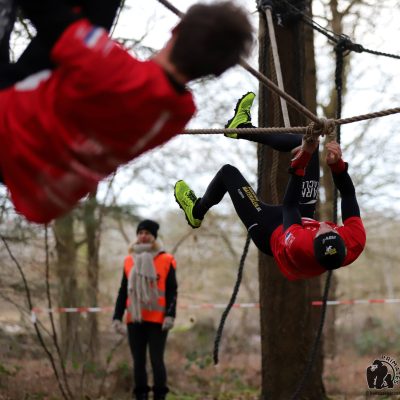
After passing through the start-finish area, we entered the 8km loop. Here, we would face the main climbing challenges, with the highlight being the Valtjemet training ground, formerly a soccer field but now entirely transformed into one large obstacle. Before we got there, we raced through a part of the village and the surrounding park. I knew I couldn’t beat Thom on climbing alone, so I decided to increase my pace slightly and build a small lead.

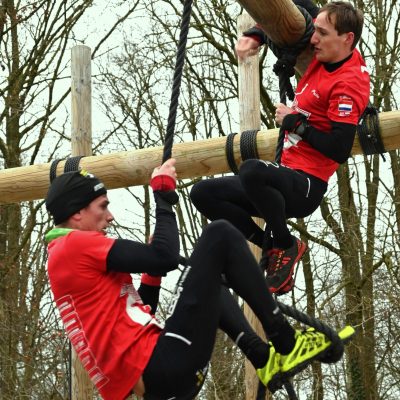
Once on the training ground, three combinations awaited us. The first two were relatively quick, including short ropes with a rope curtain. We swung through them smoothly, and it seemed like I could maintain my lead. After a short loop around the fields, we returned to the training ground. Now, a longer combination awaited us: a rope traverse with a net, followed by a 25m thick rope monkey hang. This required a lot from our forearms. Somewhat controlled, I began the obstacle, but before I knew it, Thom appeared out of nowhere next to me. In this short obstacle section, he gained about 20 seconds. I climbed along as best I could, and we both exited this obstacle at about the same time. The rest of the race continued in a similar fashion. At each obstacle, Thom closed in, allowing me to try to pull away again. This went on until we reached the training ground for the last time.

Here, the infamous long loops awaited us. We climbed neck-and-neck. Fatigue was visible in both of us. At each beam, our arms were briefly shaken to ensure the next movement—the technique of kicking the rope toward us—went smoothly. The obstacle ended with a Beltrum-style loop. It took a lot of effort to keep gripping the rope, so I eventually let myself drop from the top beam of the obstacle. We left together and entered the last kilometers.
Suddenly, I feel that there’s still something left in the tank. My arms are recovering somewhat, and I can increase my running pace. Quickly, I widen my lead, knowing that if I don’t make any mistakes now, victory is within my grasp. It’s as if I’ve started a whole new race, and everything seems to be going effortlessly. It’s remarkable how that can happen sometimes. The final part feels like a victory lap as I try to take in everything calmly: the surroundings, the obstacles, and the cheers from the spectators. I cross the finish line content and satisfied. Mission accomplished!
Now I’ve achieved my goal: the Dutch National Championship (NK) trilogy. A small detail to note is that these are three consecutive NK races, but not within the same season. As far as I know, only one athlete has accomplished that before: Stijn Elferink. So, next up is the NK Long Survival Run (LSR) in Bathmen! But before that, there’s the matter of running laps through the desert for 8 hours…


Super gaaf om te lezen. Dat je onderweg toch nog dingen ziet en meemaakt is nieuw voor mij omdat ik soms echt denk dat de eerste lopers vaak blindgangers zijn maar echt gaaf om te lezen. Erg knap gedaan Jesse. Good luck voor volgende race.
Dankjewel Marian! Ligt er maar net aan hoe diep je gaat. Soms verloopt alles als een waas haha, meestal zijn dat niet de beste races 😉